



A Clash of Authority: Federal Commission Backs White House Ballroom Amid Court Halt
In a dramatic turn of events that underscores a profound separation of powers conflict, the National Capital Planning Commission (NCPC) granted formal approval on April 2, 2026, for the White House’s proposed East Wing Modernization Project—commonly known as the new ballroom. This vote occurred just days after a U.S. district court judge issued a preliminary injunction halting all construction on the project, citing concerns over the administration’s authority to proceed without proper approvals.
The NCPC, the federal agency responsible for planning and design review of federal lands and buildings in the Washington, D.C., area, voted 8-1 in favor of the design, with two commissioners voting “present.” The sole dissenting vote came from Washington D.C. Council Chair Phil Mendelson. The commission’s approval provides a significant, though contested, layer of legitimacy for a project mired in legal and public controversy.
The NCPC’s Role and a Process Bypassed
By law, all plans for federal property development in the nation’s capital must be submitted to the NCPC for review. This typically occurs early in a project’s lifecycle. The Trump administration, however, began demolition of the White House East Wing in early 2026 without first seeking the NCPC’s input—a move widely criticized as a circumvention of mandated process. The administration’s subsequent submission of the completed ballroom design for retroactive approval placed the commission in an unprecedented position.
NCPC Chair William Scharf, a Trump appointee, directly addressed the court’s injunction at the start of the meeting. He asserted that the judicial order, which specifically binds the White House and construction crews, did not constrain the commission’s statutory duty to review submitted plans. “That order really does not impact our action here today,” Scharf stated. “The NCPC is not a party to that lawsuit. From my perspective, we have a project before us, we’ve been asked to review it, and that’s really our job here today.”
Architectural Defense and Public Overwhelmingly Opposed
Scharf framed the vote within the long history of White House evolution, citing past additions like the West Wing and the Nixon-era press briefing room that were once contentious but are now considered iconic. He predicted the new ballroom would similarly become a “national treasure” for future presidents of both parties.
This historical perspective contrasted sharply with the public sentiment documented in the official record. An analysis by The Washington Post of approximately 32,000 public comments submitted to the NCPC found that over 97% expressed opposition. Scharf acknowledged reading every comment but dismissed many as irrelevant to the commission’s narrow mandate, which focuses on design and planning compliance, not funding sources, interior décor, or political opinions of the president. “We are not some sort of free-ranging ballroom justice commission,” he said.
Commissioner Mendelson’s dissent centered on the design’s scale and the rushed process. The ballroom, with a reported capacity for 1,000 guests, is substantially larger than the Executive Mansion itself. “The issue to me is not whether there should be a ballroom,” Mendelson said. “It’s the design… It’s just too large.” He criticized the lack of a studied analysis to determine appropriate size and the absence of an iterative design process. “I think there’s a lot of value to the iterative process,” he added. “And we’ve not had that.”
Following concerns raised at the NCPC’s March meeting, architect Shalom Baranes modified the design to remove an unnecessary staircase and reconfigure another. However, the fundamental scale and footprint of the structure remained unchanged.
Asserting a Ceremonial Need
Proponents on the commission argued the project addresses a long-standing operational deficiency. Vice Chair Stuart Levenbach, another Trump appointee and a veteran of the Executive Office of the President since 2007, described the current White House as ill-equipped for modern ceremonial demands. “Our responsibility is to ensure the White House campus can support the modern presidency while still respecting the history of the place,” he said, noting that events too often require temporary tents and overcrowded spaces. Commissioner Ed Forst of the General Services Administration echoed this, stating, “We’re going to wonder why we didn’t do it earlier.”
What Comes Next: The Courts and Construction
For now, the NCPC’s approval is an official record in the project’s favor. However, the immediate future of the ballroom rests with the judiciary. The Trump administration filed an appeal within hours of the court’s initial injunction. The legal battle will likely focus on the president’s authority over federal property, the applicability of the NCPC review requirement, and whether the demolition of the East Wing—a historic structure—violated preservation laws.
The situation presents a stark standoff: a federal court has ordered a halt to physical work, while a key federal planning commission has endorsed the project’s design. Resolution will depend on appellate court interpretations of administrative law and the boundaries of executive power. Until then, construction on the $400 million project remains at a standstill, caught between a judicial pause and a commission’s controversial endorsement.
From left: NCPC Commissioner Michael Blair; White House Staff Secretary and NCPC Chairman Will Scharf; and NCPC Vice Chairman Stuart Levenbach during the April 2, 2026 meeting. [Photo: Al Drago/Getty Images]
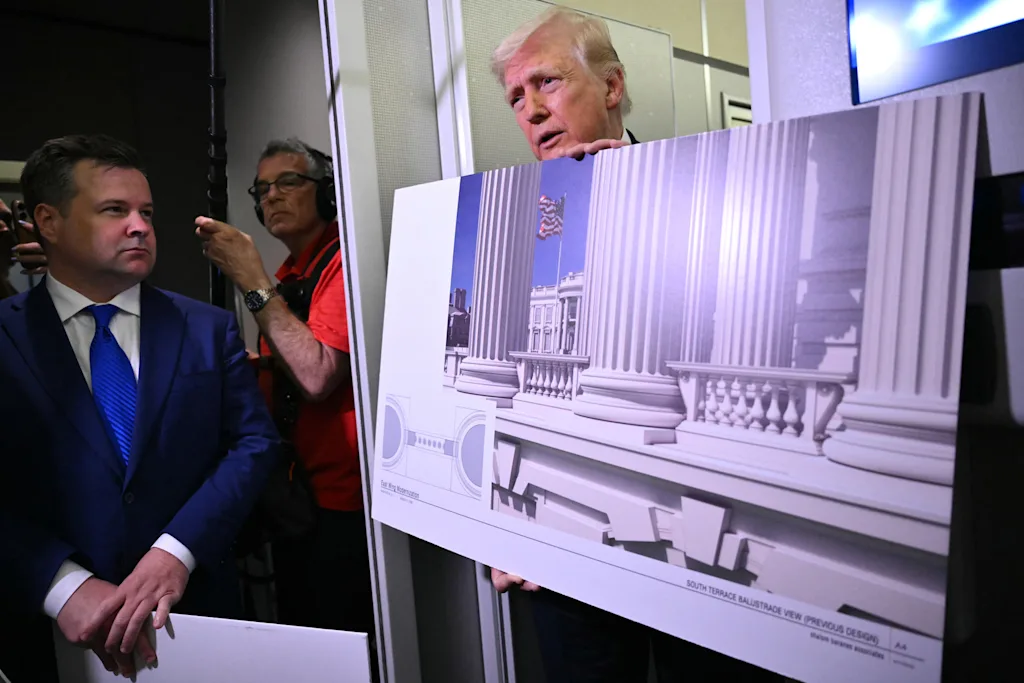
President Donald Trump holds a rendering of the White House South Terrace balustrade view aboard Air Force One on March 29, 2026. [Photo: Mandel Ngan/AFP/Getty Images]